
Best AI Prompts for Copywriting & Marketing: The Ultimate Guide for 2025

In today's digital landscape, AI has revolutionized how marketers and copywriters create compelling content. With the right prompts, tools like ChatGPT, Claude, and other AI assistants can generate high-converting copy in seconds, saving you hours of work while maintaining quality and creativity. This comprehensive guide will walk you through the most effective AI prompts for various copywriting and marketing tasks, helping you maximize your productivity and results.
Why AI Prompts Matter in Copywriting and Marketing
Before diving into specific prompts, it's essential to understand why well-crafted AI prompts are crucial for marketing success.
According to recent statistics, nearly 80% of readers never go beyond the headline, making attention-grabbing copy more important than ever. Meanwhile, email marketing continues to deliver the highest ROI of all marketing channels, generating nearly $36 for every $1 spent [Narrato](https://narrato.io/blog/60-powerful-chatgpt-prompts-for-copywriting/).
The difference between mediocre and exceptional AI-generated content lies in the quality of your prompts. Poorly written prompts typically result in generic, uninspired content that lacks originality and fails to align with specific business needs. On the other hand, well-crafted prompts guide the AI to generate focused, engaging, and on-brand content that resonates with your target audience.
How to Structure Effective AI Prompts
The structure of your prompt significantly influences the quality of AI-generated copy. Here's a proven framework for creating effective AI prompts:
The 5 Key Components of Effective AI Prompts
1. **Context/Role**: Define the AI's role or perspective (e.g., "Act as an experienced e-commerce copywriter specializing in luxury products")
2. **Task Description**: Clearly state what you want the AI to create (e.g., "Write a product description for...")
3. **Specific Details**: Include product features, audience information, tone preferences, etc.
4. **Format Requirements**: Specify length, structure, or formatting needs
5. **Additional Parameters**: Include any constraints, specific keywords, or special instructions
Sample Template Structure
Here's a general template you can adapt for various copywriting needs:
```
You are a [role/expertise]. Create [specific content type] for [product/service/company] targeting [audience].
The content should emphasize [key selling points/benefits/features] and should be written in a [tone/style] voice.
Include [specific elements] and make sure to [specific instructions].
Format the content as [desired format] with a length of approximately [word count/character count].
```
40+ Powerful AI Prompts for Different Copywriting Needs
Now, let's explore effective prompts for various copywriting tasks, organized by category.
1. Headlines and Attention-Grabbing Titles
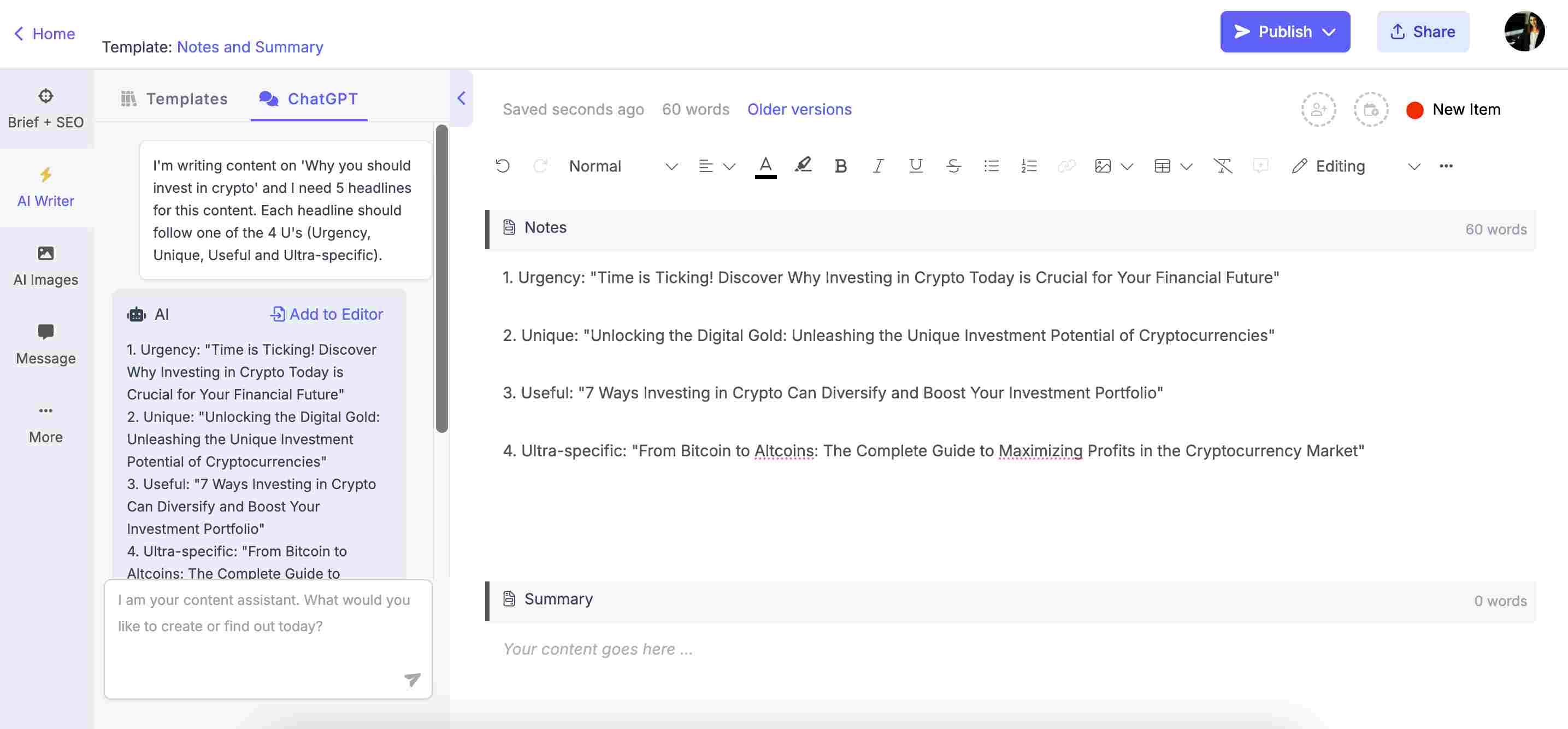
Headlines are your first opportunity to capture attention. These prompts will help you create compelling headlines that drive clicks:
1. "Generate 10 attention-grabbing headlines for a blog post about [topic]. Each headline should follow one of the 4 U's (Urgency, Unique, Useful and Ultra-specific)."
2. "Create 5 headline options for a Facebook ad promoting [product/service]. The headlines should be under 40 characters and include power words that evoke [emotion]."
3. "Write 8 curiosity-driven headlines for an email newsletter about [topic]. Include numbers and specific benefits where appropriate."
4. "Generate 7 'how-to' headlines for a LinkedIn article about [topic] targeting [specific professional audience]."
5. "Create a headline using the PAS (Problem-Agitate-Solution) framework for [product/service] that addresses [pain point]."
2. Product Descriptions That Convert
Effective product descriptions don't just describe features—they sell benefits and create desire. Use these prompts to craft compelling product descriptions:
1. "Write a 150-word product description for [product name], highlighting [3-5 key features] and how they benefit [target audience]. Use sensory language and include a clear call-to-action."
2. "Create an engaging product description for [product] that focuses on solving [specific customer problem]. Incorporate social proof and address potential objections."
3. "Write a luxury product description for [high-end product] that evokes exclusivity and premium quality. Focus on craftsmanship, materials, and the emotional benefits of ownership."
4. "Generate a comparison-style product description that positions [your product] against [competitor products], highlighting unique advantages without directly naming competitors."
5. "Create a technical product description for [B2B product/service] that balances technical specifications with clear business benefits for [decision-maker role]."
3. Email Marketing Copy
Email remains one of the most effective marketing channels. These prompts will help you craft emails that get opened and drive action:
1. "Write a welcome email for new subscribers to [brand/newsletter name]. Include a brief introduction to the brand, what subscribers can expect, and a small offer to encourage engagement."
2. "Create a promotional email for [product/service] that follows the AIDA framework (Attention, Interest, Desire, Action). Include a limited-time offer and clear CTA."
3. "Generate a re-engagement email sequence (3 emails) for inactive subscribers who haven't opened emails in 90 days. Focus on providing value and curiosity rather than being pushy."
4. "Write a post-purchase follow-up email for customers who bought [product], including care instructions, complementary product suggestions, and an invitation to leave a review."
5. "Create an abandoned cart email that addresses common objections, reinforces key benefits of [product], and includes both rational and emotional reasons to complete the purchase."
4. Social Media Content
Social media demands concise, engaging content tailored to each platform. Use these prompts to create platform-specific posts:
1. "Create 5 Instagram captions for posts promoting [product/service]. Each caption should be under 150 characters, include relevant hashtags, and a question to encourage engagement."
2. "Write 3 LinkedIn posts announcing [company news/achievement] that positions the company as a thought leader in [industry]. Include relevant statistics and a call for audience opinions."
3. "Generate 7 Twitter posts (under 280 characters) for a week-long campaign promoting [event/product launch]. Include varied CTAs and appropriate hashtags."
4. "Create 4 Facebook posts introducing a new [product/feature] to existing customers. Include social proof elements and specific use cases that solve customer problems."
5. "Write 3 TikTok/Reels video script concepts for showcasing [product] in action. Each script should be 15-30 seconds, include a hook, demonstration, and CTA."

5. Ad Copy for Various Platforms
Effective ad copy must capture attention quickly and drive specific actions. These prompts will help you create platform-specific ad copy:
1. "Write 3 versions of Google Search ad copy for [product/service] targeting the keyword '[main keyword]'. Include a compelling headline, description (90 characters max), and call-to-action that addresses [pain point]."
2. "Create Facebook ad copy for [product] targeting [demographic]. Include primary headline (25 characters), secondary headline (30 characters), and body text (125 characters) that highlights [key benefit]."
3. "Generate LinkedIn sponsored content ad copy for [B2B service] targeting [job title]. The copy should position the service as solving [industry challenge] and include a clear next step."
4. "Write Instagram Story ad copy with a swipe-up CTA for [product/promotion]. Include attention-grabbing opening line and value proposition that resonates with [target audience]."
5. "Create YouTube pre-roll ad script (15 seconds) for [product] that hooks viewers in the first 5 seconds and delivers [key message] before they can skip."
6. Website Copy and Landing Pages
Your website copy needs to communicate value quickly and guide visitors toward conversion. These prompts will help you create effective website content:
1. "Write a homepage hero section for [business type] that includes a headline, subheadline, and primary CTA. Focus on [key value proposition] and address the main pain point of [target audience]."
2. "Create an About Us page for [company] that tells the brand story, highlights the mission and values, and builds credibility with potential customers in the [industry] space."
3. "Generate copy for a landing page promoting [offer/lead magnet] using the PAS (Problem-Agitate-Solution) framework. Include headline, 3-5 bullet points of benefits, social proof section, and a compelling CTA."
4. "Write a services page for [service business] that clearly explains the [service] process, differentiators, and outcomes clients can expect. Include FAQs addressing common objections."
5. "Create website copy for a pricing page that explains the value of each tier of [product/service], highlights the best-value option, and addresses potential hesitations about cost."
7. Call-to-Action (CTA) Prompts
The right CTA can significantly impact conversion rates. These prompts will help you create CTAs that drive action:
1. "Generate 10 CTA button text options for [specific action] that create urgency without using clichéd phrases like 'Click Here' or 'Submit'."
2. "Create 5 CTAs for [product type] that address different stages of the customer journey from awareness to decision."
3. "Write 3 pairs of primary and secondary CTAs for a [landing page type] that allow visitors to either convert immediately or take a smaller step toward conversion."
4. "Generate 7 CTAs that utilize the FOMO (Fear Of Missing Out) principle for a limited-time [offer/promotion]."
5. "Create 5 benefit-focused CTA phrases for [product/service] that emphasize what the user gains rather than the action they're taking."
8. SEO-Optimized Content Prompts
Content that ranks well must balance search optimization with reader engagement. These prompts will help you create SEO-friendly content:
1. "Write a SEO-optimized introduction (250 words) for a blog post targeting the keyword '[target keyword]'. Include related keywords [keyword 1, keyword 2] naturally while engaging the reader and previewing what the article will cover."
2. "Create 5 SEO-optimized H2 subheadings for an article about [topic] targeting the keyword '[main keyword]'. Each subheading should include a relevant keyword variation while being compelling to readers."
3. "Generate a 300-word product category description for an e-commerce site selling [product category]. Naturally incorporate the keywords [list of keywords] while providing useful information for shoppers."
4. "Write a meta description for a blog post about [topic] that includes the keyword '[target keyword]', stays under 155 characters, and encourages clicks from search results."
5. "Create an FAQ section (5 questions and answers) for a page about [topic] that addresses common search queries related to [main keyword] while providing genuinely helpful information."
Advanced Prompt Engineering Techniques for Better Results
To take your AI-generated copy to the next level, implement these advanced prompt engineering techniques:
1. Use the Chain-of-Thought Approach
Break complex copywriting tasks into smaller steps by guiding the AI through a logical sequence:
"To create compelling ad copy for [product], follow these steps:
1. First, identify 3 key pain points of [target audience]
2. For each pain point, explain how [product] solves it
3. Create emotional hooks based on these solutions
4. Develop 3 headline options based on the most compelling hooks
5. Write supporting copy for each headline (50 words max)
6. Suggest a CTA that aligns with each headline/copy combination"
2. Implement Persona-Based Prompting
Frame your prompts from the perspective of your ideal customer or a specific expert:
"You are [customer persona] who has just discovered [product/service]. Write a testimonial highlighting what specific problems it solved for you, what benefits you experienced, and why you would recommend it to others like you."
Or:
"Act as [renowned copywriter] known for [specific style/approach]. Create ad copy for [product] targeting [audience] using your signature techniques."
3. Use Comparative Frameworks
Ask the AI to generate content using different copywriting frameworks for comparison:
"Write ad copy for [product] using these three frameworks:
1. AIDA (Attention, Interest, Desire, Action)
2. PAS (Problem, Agitate, Solution)
3. BAB (Before, After, Bridge)
Then explain which approach is likely to be most effective for [target audience] and why."
4. Iterative Refinement Prompts
Use follow-up prompts to refine initially generated content:
"Review the following copy for [product/service]: [insert generated copy]
Now improve it by:
1. Making the headline more specific to [target audience]
2. Adding sensory language to the description
3. Strengthening the urgency in the CTA
4. Incorporating the brand voice characteristics of [brand]: [list characteristics]"
Common Mistakes to Avoid When Using AI for Copywriting
Even with perfect prompts, there are several pitfalls to watch out for when using AI for copywriting:
1. Lack of Specificity
**Problem**: Vague prompts like "Write product description" or "Create ad copy" without details.
**Solution**: Always include specific information about the product, target audience, brand voice, and desired outcome.
2. Ignoring Brand Voice
**Problem**: Generic copy that could be for any brand, lacking distinctive personality.
**Solution**: Include brand voice guidelines, examples of previous copy, and specific tonal direction in your prompts.
3. Accepting First-Draft Output
**Problem**: Using AI-generated content without editing or refinement.
**Solution**: Treat AI output as a first draft that needs human review, editing, and optimization.
4. Overlooking Legal and Compliance Issues
**Problem**: Generated copy that makes unsubstantiated claims or violates industry regulations.
**Solution**: Include compliance requirements in your prompts and always review content for legal issues before publishing.
5. Neglecting Human Emotion
**Problem**: Copy that is technically correct but lacks emotional connection.
**Solution**: Specifically request emotional elements, storytelling, and relatable examples in your prompts.
Tools to Enhance Your AI Copywriting Workflow
While ChatGPT is a popular choice for copywriting, several specialized tools can enhance your AI copywriting workflow:
1. **Narrato's AI Copywriter**: Offers over 100 templates for generating everything from landing pages to product descriptions, with support for various writing frameworks like AIDA, PAS, and BAB.
2. **TypeFace**: Features advanced AI-powered ad generators that create unique ads by considering platform-specific needs, performance data, and brand guidelines.
3. **AirOps**: Provides Growth Templates designed specifically for marketing tasks, with support for multiple AI models and customizable workflows.
4. **Jasper AI**: Specializes in marketing content with templates designed specifically for various copywriting needs.
5. **Copy.ai**: Focuses on generating marketing copy with specialized templates for different platforms and purposes.
The Future of AI in Copywriting and Marketing
As AI continues to evolve, we can expect even more sophisticated tools and capabilities for copywriters and marketers. Here are some trends to watch:
1. **Hyper-personalization**: AI will increasingly generate copy tailored to individual user preferences, behaviors, and past interactions.
2. **Multimodal Content Creation**: Integration of text, image, and video generation in unified AI systems will allow for seamless multimedia marketing content creation.
3. **Real-time Optimization**: AI will test and refine copy in real-time based on performance data, continuously improving conversion rates.
4. **Enhanced Brand Voice Preservation**: More sophisticated AI will better capture and maintain consistent brand voice across all content.
5. **Collaborative AI Tools**: New interfaces will allow marketers and AI to work together more intuitively, with AI handling repetitive tasks while humans focus on strategy and creativity.
Conclusion: Balancing AI and Human Creativity
AI-powered copywriting doesn't replace human creativity—it enhances it. The most effective approach is to use AI as a powerful assistant that handles the heavy lifting of generation and iteration, while you focus on strategy, brand alignment, and adding that unique human touch that truly connects with audiences.
By mastering the art of prompt engineering and understanding how to effectively collaborate with AI, you'll be able to create more compelling copy in less time, experiment with different approaches, and ultimately drive better marketing results.
Remember that the quality of your output depends largely on the quality of your input. Invest time in crafting thoughtful, detailed prompts, and you'll reap the rewards of AI-enhanced copywriting that truly resonates with your audience and achieves your marketing goals.
What AI copywriting prompts have worked best for you? Share your experiences in the comments below!


0 Comments